
The Trillion dollar industry
At the time of writing, the Waikato DHB cyber-attack is ongoing. The government is refusing to pay the ransom as a point of principle, and it looks like every possible tool at their disposal is being used to try to recover the situation.
Should they just pay the ransom? Or should the government go further and make it illegal to pay ransoms in New Zealand? That’s the question that Minister Kris Faafoi is having to assess at the moment. DHB attack: Why Justice Minister Kris Faafoi won’t make it illegal to pay a cyber-ransom – NZ Herald
Cyber crime is big business. We’ve called it organised crime in previous articles and we’re happy to stick with that. These organisations recruit the best and brightest out of the top universities, and give them both the latest tools and time to wreak havoc. Their recruits are paid astronomical sums to work for them, overcoming any moral objections with immorally large pay checks. These paychecks are funded by the proceeds of previous hacks. Every time they are paid, their war chest is strengthened. For example, we recently saw the Colonial Pipeline in the eastern US get hacked for 75 bitcoins (just under US$4M) which went to a criminal group called ‘Darkside”.
So, will cutting off payments stop their attacks by removing the incentive?
These criminals are smart and highly motivated. They seem to have no conscience but plenty of greed. Waikato is not only the hospital being brought down – there was a huge wave of hospital attacks in the US in October, just a few months ago – Several hospitals targeted in new wave of ransomware attacks – CNNPolitics.
I don’t know how Waikato DHB got infected, but the rumour is that it was from phishing attacks onto machines that weren’t fully patched up to date. We don’t know if that is true, but it is a common attack vector. Once a hacker gets into a system, they often hold back and try to dig further looking for more vulnerabilities they can exploit. The more damage they can cause, the more ransom they can demand, so they will often use one vulnerability to find the next, and so on until they finally have enough to bring the house down.
Security is all about layers. There is NO way to prevent attacks, and it is impossible to guarantee that any system is invulnerable. We saw that with the recent Hafnium attack where a vulnerability was exploited before patches were available to block it. But the more layers of security, the harder you make it, and you reduce the scope of any harm.
Today, even if you have the best backups and can recover the system, the hackers then threaten to release the data you hold to media or competitors. In the case of the Waikato DHB, it is being reported that personal data is being released to media by the hackers to increase pressure, even as they fail to stand their systems up.
As to paying the ransom, I suspect your perspective changes when your business, your job or livelihood is threatened. Not an easy decision and hopefully one we can avoid by being paranoid.
The best solution we can recommend is to check your cyber insurance and to apply the best security you can reasonably afford, which should be more than you had last year. Expect it to be more again next year as new tools and new threats emerge. Consider managed security solutions like our KARE Plans.
We don’t know where this will end, or if it will end, but let’s hope so. It is such a drain on our resources and holds us back from investing in tools that make us more productive.

Will this really ‘break’ the internet?
[header2 text="What is news?" align="left" color="#336A40" margintop=""] There's nothing worse than accidentally clicking on a daft click-bait link that re-directs you to a dodgy, untrustworthy website. They are all too common, with news you can't trust, and...

What are @Mentions in Office?
How many times,. when you are working on documents with someone else, do you want to ask them a question? "Why did you add (or remove) this section?", "How does this calculation work?" and so on. So, you stop what you are doing, send them an email or make a phone...

Tech like it’s 1999
This week, we've seen some pretty interesting tech announcements - I confess the foldable phones really interest me. While these are crazily expensive now, volume will bring the price down. But what's really interesting is imagining this tech in other applications...

Three Cyber-Insurance questions you need to consider
With all necessary attention on cyber-security and fraud, we've had a couple of people asking us about insurance solutions. This makes sense, insurance is all about mitigating risk. Of course, insurance doesn't give you a license to be careless - you still need to...

Code Red? Hacker alert
One of our clients recently found themselves dealing with one of the most brazen hack attempts I've heard to date. They'd heard from one of their customers that they (the customer) had taken a phone call purporting to be from our client, to say they'd changed...

Three every day timesaving tips
Here's three quick time-saving tips - how many did you already know? [wow_colorme]1. Reading (or writing) long - how much time do you spend scrolling up and down long emails or documents as you make sure the content fits together?[/wow_colorme] Introducing...
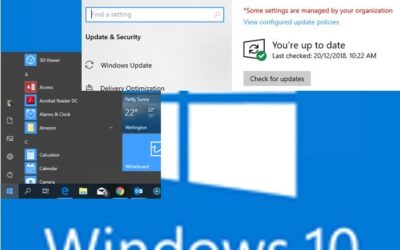
What’s with Windows updates now?
Is MY Windows 10 still the latest and most stable question? It's not a question we can easily answer. Windows 10 has two different update cycles - security/reliability updates (aka patches) and feature updates. Security updates are incredibly important. They are the...

Is it ok for the (Australian) government to read your data?
Late last year, the Australian Government introduced the Assistance and Access Act. This new legislation makes it mandatory for any organisation whose website or data is hosted in Australia to give Australian authorities access to their IT system if requested....

Don’t be fooled! FAKE problems.
Wow, some of the phishing hacks are getting smart! While we haven't seen this particular one ourselves yet, it's certainly good enough to fool most people! (so beware!) The clue is that it's emailed to you - a message like this wouldn't come as an email, and...

Cake Group Case Study – making paperless real
"Everyone talks about going paperless. But really achieving that has enabled us real-time feedback on health and safety on-site, our quality compliance has increased massively and our clients now have live access to work we are carrying out for them" - Dean Wall,...